
Jonesville Public Use Area Regulations Update
General Information

The Jonesville Public Use Area (JPUA) is a legislatively designated Public Use Area (AS 41.23.280 - 41.23.289) established in 2017. Like other public use areas in the state, it was set aside to protect, maintain, enhance, and perpetuate the year-round recreation and to protect and maintain fish and wildlife habitat so that the public may continue to enjoy traditional uses of the Jonesville Public Use Area. The JPUA provides opportunities for the public to enjoy the area through a full spectrum of public uses, including the maintenance and enhancement of off-road vehicle and nonmotorized recreational opportunities while allowing continued mineral exploration and development, and motorized access to private property. The JPUA consists of approximately 14,614 acres of state-owned lands located off the Jonesville Mine Road in Sutton, AK, off the Glenn Highway. The majority of the JPUA lies within another legislatively designated area, the Matanuska Valley Moose Range.
In October 2026, the Alaska Department of Natural Resources issued a Notice of Proposed Changes to Regulations on Public Use Areas, focused specifically on the JPUA and incidentally on the larger Matanuska Valley Moose Range Management Plan. These changes would update 11 AAC 96 of the Alaska Administrative Code, dealing with designated public use areas including the following:
- 11 AAC 96.016 is proposed to be amended to make conforming language and citation changes and to add new subsections that regulate activity in the Jonesville Public Use Area.
- To add a new section, 11 AAC 96.017, that regulates activity in the Matanuska Valley Moose Range.
- 11 AAC 96.020(a) is proposed to be changed to make conforming citation amendments.
- 11 AAC 96.030(a) is proposed to the changed to clarify language.
- 11 AAC 96.250 is proposed to be changed to amend and add new definitions for “motorized vehicle,” “explosive,” “firework,” “explosive device,” “designated public use site,” “organic mat,” “permit,” and “wetlands.”
For more information on the proposed regulations, please see:
Notice on Alaska Public Notices Public Notice PDF Proposed Changes to Regulations PDFMap of area impacted by proposed regulations
This map is from the Matanuska Valley Moose Range and Jonesville Public Use Area Management Plan, page 3-25.
Please note that this map does not reflect the boundary change created under SB 230 on 7/1/2026.
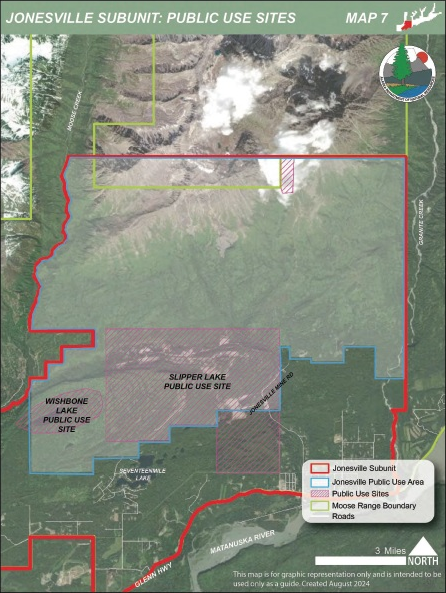 Map of Area Impacted by Proposed Regulations (high-resolution)
PDF
(7/2/2024)
Questions & Answers
Question 1: Can a map of the area in question be made available?
Answer: The Department has now provided a map of the area affected by the proposed regulations. It has been attached to the Online Public Notices Notice and can also be found on this page.
Question 2: The proposed regulation prohibits target shooting throughout the Moose Range except in a 'lawfully designated shooting area.' Please identify all currently designated shooting areas within the Moose Range and the legal process by which additional shooting areas may be designated in the future.
Answer: None have been designated. Currently, a cooperative resource management agreement (CRMA) for a shooting range is out to public notice between the State of Alaska and the Mat-Su Borough to establish one near Slipper Lake. Please refer to the Notice of Application on Alaska Online Public Notices for more information. Future shooting areas may be designate by administrative decision from the Division of Mining, Land and Water (DMLW).
Question 3: Multiple questions addressed the proposed speed limit in 11 AAC 96.016(e):
- What specific safety incidents or documented problems support the 10-mph speed limit?
- 10-mph speed limit in designated areas may sound reasonable on paper, but what is the justification for that specific limit? What problems are these regulations intended to solve, and what evidence shows these restrictions are necessary?
- Adding these permitting requirements without public comment or justification is unreasonable. What is the reason for this proposed change to the current policy?
- What is the proposed regulation trying to change or what is the DNRs goal?
- Why were less restrictive alternatives to the 10-mph speed limit not sufficient?
- What does it matter? Who rides it only 10 miles an hour?
Answer: This speed restriction applies only in areas where people and vehicles are in close proximity. In the Knik River Public Use Area at Man-Made Lake, the mix of small children, campers, fire rings, and heavy foot traffic created repeated close-call situations. The 10-mph limit was implemented there to address those issues and has proven effective in reducing conflicts and improving safety.
Because Slipper Lake has the same kind of high-use patterns and similar safety concerns, the same measure was applied to ensure consistent protection for everyone using the area. The goal is simply to maintain safe conditions, using a 100-foot buffer in locations where families and recreationists are immediately adjacent to moving vehicles.
Question 4: Multiple questions addressed the proposed permit in 11 AAC 96.016(e):
- What objective standards will determine who receives permission to exceed the speed limit?
- What will the permit require; what will cost; who will qualify for the permit; and what are the rounds for revocation?
- One commenter also requested that the department publish the terms of the permit, then re-open the public comment period.
Answer: If a person applies for a permit and proposes alternative safety measures that adequately protect pedestrians and other users, DMLW may review the request and, if appropriate, approve the request in writing. For example, an organized event with clearly defined and effective safety controls may be considered for a permit to exceed the posted speed limit. An example of an existing permit type for events is the OTC Events Form PDF , which can be found on DMLW's Forms Page.
At this time, DMLW has not drafted a specific permit under 11 AAC 96.016(e) for exceeding the speed limit. Because no permit language currently exists, details such as requirements, qualifications, costs, and grounds for revocation have not yet been established. Should DMLW develop such a permit in the future, the department will provide the terms and conditions at that time. However, DMLW does not intend to extend the public comment period.
Question 5 Regarding Enforcement: Multiple members of the public asked the following enforcement-related questions:
- Which agencies and personnel will be responsible for enforcing these regulations, particularly relating to permits and speed limits?
- Will additional resources, funding, staffing, and interagency agreements be necessary to ensure enforcement is effective?
- Who will pay for enforcement?
- Will there be regular enforcement patrols within the Jonesville Public Use Area?
- How should residents report violations?
- What response can residents expect when violations are reported?
Answer: Enforcement will be carried out collaboratively by DNR staff and law enforcement. For example, at the Knik River Public Use Area, enforcement is achieved through site visits by DNR staff, Alaska State Troopers, and Alaska Wildlife Troopers, backed by enforceable rules with citations. Members of the public should report violations to the Alaska State Troopers.
Question 6: What resources and enforcement measures will DNR devote to illegal dumping, abandoned vehicles, squatting, dangerous shooting, and explosives? How will the proposed restrictions improve enforcement of those existing problems?
The major problems I see in the Jonesville area are illegal dumping, abandoned vehicles, unauthorized occupation, and dangerous shooting practices. Why not focus enforcement and resources on those problems instead of imposing additional restrictions on responsible recreational users throughout the area?
I do support the restrictions against dumping trash, vehicles, hazardous materials, temporary structures, etc. Can DNR confirm whether these activities are presently illegal? If so, why are these activities not being enforced and how would additional DNR restrictions support this?
Answer: DNR is prioritizing comprehensive enforcement in legislatively designated public use areas. Using the Knik River Public Use Area as a model, DMLW is designating clear "citable offenses" (e.g., dumping, abandoned vehicles, unsafe shooting), installing signage, conducting regular site visits, and hosting public outreach and cleanup events. Similar strategies will apply in the Moose Range/Jonesville area. This coordinated enforcement structure is expected to deter violations and improve the area.
DNR is taking these concerns under consideration.
Question 7 Regarding Permits: Members of the public asked the following questions related to permits:
- How much will the permit cost?
- How will the public apply for a permit?
- How long will it take to get a permit?
- Which activities will require a permit?
- Will there be a limit on the number of permits issued?
- What are the requirements for eligibility?
- What are the objective standards for granting or denying permits?
- How many staff will be dedicated to processing permits?
- Will additional training eventually become mandatory?
- Why is there a provision stating that permits will be revocable without cause?
- What is the process for challenging a denial or revocation?
- Why do we need to apply and pay for a permit to access the land that we already own?
Answer: Please see Question 4 above for responses to earlier questions relating to permits.
DNR is taking these concerns under consideration.
The area remains open and no permit is required for access by any members of the public.
Question 8 Regarding Trail Maintenance: Members of the public asked the following questions related to trail maintenance:
The proposed prohibition on constructing, developing, improving, widening, brushing, or otherwise creating roads and trails raises questions about ordinary maintenance of existing trails. If a tree falls across an established trail, may a recreational user remove or cut up the fallen tree to restore passage? May volunteers clear storm debris or trim vegetation encroaching on an existing trail? Would these activities require a permit? Please expressly exempt routine maintenance of existing trails from permitting requirements, provided the work does not expand the trail, cause significant ground disturbance, or otherwise damage public resources.
I am also concerned about provision (12) regarding the ability to create or maintain trails in the public use sites. The ability to create and maintain trails (along with associated cutting of trees/limbs) is critically needed for safety and access. Similarly, DNR does not currently have the capacity to maintain its existing trail network. Can DNR share how many staff it will instead make available to maintain a trail network for recreation users and how often they will be visiting the site to perform work?
DOT&PF requests clarification regarding proposed 11 AAC 96.017(a)(12), particularly the permitting requirements for brushing and maintenance of existing trails. Routine maintenance, including brushing, clearing obstructions, winter trail grooming, and replacement of trail markers, is important to maintaining safe recreational access.
DOT&PF recommends clarifying whether these activities require individual permits and, where appropriate, providing a streamlined authorization process for routine maintenance of established trails. This clarification would help ensure that the proposed regulations protect public resources while allowing continued maintenance of existing recreational trails and winter transportation routes.
Answer: No permit is required for routine trail maintenance that doesn't expand the trail or significantly disturb ground or public resources. Under 11 AAC 96.020, recreational brushing or clearing existing trails less than five feet wide using handheld tools is generally allowed. These activities such as cutting a fallen tree, trimming back intruding branches, or removing storm debris are consistent with generally allowed maintenance and are expressly exempted from permitting, as long as they don't expand trails or damage resources.
Question 9 Regarding Speed Limits: Multiple members of the public questioned the need for speed limits.
Answer: Please see Question 3 above for responses to earlier questions relating to speed limits.
DNR is taking these concerns under consideration.
Question 10: Multiple members of the public questioned the need for the proposed changes to the regulations.
Answer: The purpose of the proposed changes to regulations is to maintain safe conditions.
Question 11: Multiple members of the public inquired about firearms and shooting, safety issues, and the need for a designated shooting range.
Answer: DNR is taking these concerns under consideration. Please see the response above to Question 2 relating to shooting areas.
Question 12:
What specific methods were used to notify residents and property owners in the Sutton and Jonesville areas of the proposed regulations and the public comment period?
Were any notices mailed directly to residents or property owners? If so, how was the mailing area determined, and did it include affected residents with Palmer mailing addresses?
Were notices distributed to the Sutton Community Council, local businesses, or other community organizations for public distribution?
In addition to publication on the Alaska Online Public Notice System, what outreach was undertaken specifically to reach residents living near the Jonesville Public Use Area?
Does DNR plan any additional community notification before the November 9 public comment deadline?
Answer: DNR follows the notification requirements under AS 44.62.190, including newspaper publication, posting on the Alaska Online Public Notice System, and distribution to incumbent legislators, the Department of Law, and other interested parties. The notice was also posted on DMLW's website, Facebook page, and this project webpage.
Question 13: I noticed that there is a new plan for the Jonesville mine area. I see that the new plan no longer has a shooting range area down near slipper lake where there was 2 area for shooting ranges. Is there any info for clarification on the proposed shooting ranges?
Answer: DNR has never designated a shooting range on state land within this area. Please see the response above to Question 2 relating to shooting areas.