The Nenana-Totchaket Agricultural Project brings to Alaska the hope of additional food security from its own soil.
This project is unique, as it will be planned using science to optimize sustainable production of food, fiber, and fuel,
while keeping Alaska's land and water healthy and our soils productive.
The project will continue to grow for generations and become a vital key to our agricultural industry and the state's economy.
Greetings fellow Alaskans, Americans, & farmers of the world.
Alaska is a land of abundant natural resources and with those resources, a land with great opportunities.
Alaska has set the bar for sustainable resource management with the responsible development of our unmatched fish and timber industries.
Alaska is positioned as a "crossroad" in the global transportation system, with international air and seaports.
This unique position increases our value to the United States and the rest of the world as a major hub for world commerce.
We invite you to learn more about another of our renewable resource industries, agriculture;
and the State's plan to develop 100,000 plus acres of agricultural land.
While climate change is impacting this state (and the world) in challenging ways,
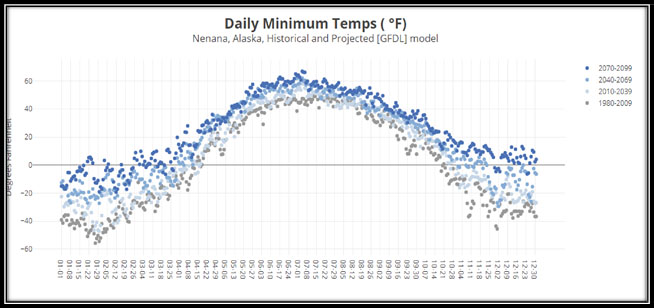
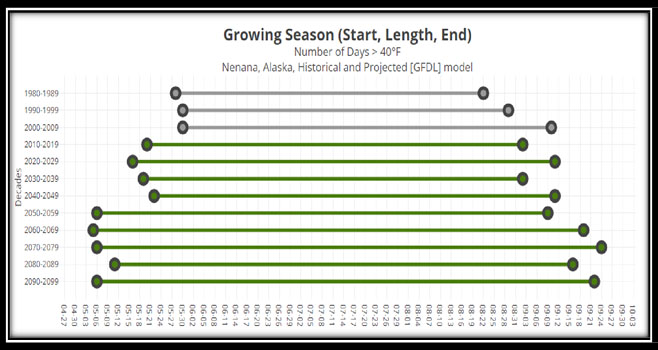
it has also created longer growing seasons and warmer days here in Alaska.
With our clean air, water, and soil in "the land of the midnight sun", Alaska's long-term future as an agricultural producer has never looked brighter.
The Nenana-Totchaket area was planned as a farming project decades ago,
but access to the area limited the agricultural development to gain traction.
A new bridge recently constructed over the Nenana River was the key to unlocking the development of millions of acres of
land owned by the State, Alaska Native Corporations, and the University of Alaska.
The Nenana-Totchaket Agriculture Project will be designed around the concepts of economic viability and environmental stewardship.
It is being developed with input from our stakeholders in federal, tribal, state, local and private citizen groups.
It is important to the development of new farms and farmers which will bolster Alaska's future food security and the State's economy.
The Alaska Department of Natural Resources is committed to continue to support this project with ongoing development of
infrastructure, research and support from the Division of Agriculture and our agency partners.
"The Nenana-Totchaket Agricultural Project brings to Alaska the hope of additional food security from its own soil,"
said Alaska's Governor Mike Dunleavy.
"This project is unique, as it will be planned using science to optimize sustainable production of food, fiber, and fuel,
while keeping Alaska's land and water healthy and our soils productive.
The project will continue to grow for generations and become a vital key to our agricultural industry and the state's economy."
With access barriers removed combined with increased interest in the Nenana-Totchaket Agricultural Project development,
the Department of Natural Resources, Division of Agriculture, engaged in the planning process utilizing
cutting edge remote sensing technologies such as LiDAR, photography and other tools for landscape analysis.
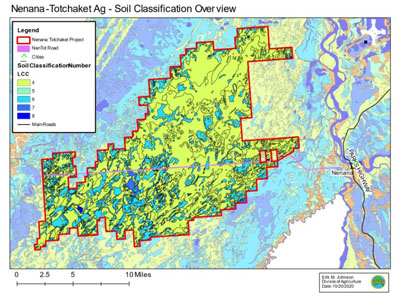
To gain a better understanding of the soils in the project area, the Natural Resources Conservation Service (NRCS)
has been contracted to do detailed soil surveys.
"The Nenana-Totchaket Agriculture Project will be designed around the concepts of economic viability and environmental stewardship,"
said former Director David W. Schade.
"It is being developed with input from our stakeholders in federal, tribal, state, local and private citizen groups.
It is important to the development of new farms and farmers which will bolster Alaska's future food security and the State's economy.
The Nenana-Totchaket Agricultural Project will synergize the latest agricultural technologies with time-tested sustainable
production practices for responsible agricultural land development. Feel free to check out our updates as they become available.