Skip Navigation
State of Alaska Home Page

Parks Boating Safety Hist./Archaeology Grants Design Trails Volunteers Index
Natural Resources

Office of Boating Safety - words
    State of Alaska > Natural Resources > Parks and Outdoor Recreation > Boating Safety

Kids Don't Float Program

kdf sticker    ABOUT KIDS DON'T FLOAT
Kids Don’t Float (KDF) is a statewide injury prevention program that was developed to address Alaska’s high child and youth drowning rate. A collaborative effort between several state and federal agencies, organizations, and local grass-roots sponsors, KDF includes both a life jacket loaner station component and an educational component.


HISTORY
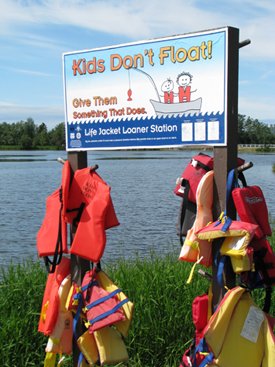
Kids Don’t Float began in Homer, Alaska in early 1996. The Homer Fire Department, with a grant from the Alaska Department of Health and Social Services, collaborated with Homer Safe Kids, the U.S. Coast Guard Auxiliary, and the Homer School District to establish 15 life jacket loaner stations in communities around Kachemak Bay. The stations, or “loaner boards,” display life jackets that can be borrowed at no cost and returned after use. The public response was so positive that, in November of that same year, the Alaska Department of Health and Social Services Section of Community Health and EMS, the U.S. Coast Guard District 17 Recreational Boating Safety Program, and Alaska Safe Kids partnered to expand the program. In 2000, the newly established State Office of Boating Safety joined the partnership.


LOANER BOARD PROGRAM
Alaska’s Kids Don't Float life jacket loaner board program has been a success. More than 466 KDF loaner boards have been placed in communities around the state, hosted by many different agencies, organizations, and individuals. At least fifteen Alaskan children are known to have survived a near-drowning accident because of a Kids Don't Float life jacket. In a 1997 study, the observed life jacket wear increased from 16% to 35% at a loaner board site immediately following its installation. A 2001 observational wear-rate study conducted by the Alaska Boating Safety Program, the U.S Coast Guard D 17 and the Alaska Department of Health and Social Services, showed that the wear rates of children between 0 and 17 years of age increased by 25% in those areas with loaner boards.    loaner board picture


kdf class1    EDUCATION
The Kids Don’t Float School Program is a model curriculum for anyone wishing to teach boating and water safety concepts to K-12 students. The curriculum is comprised of several short lessons that include activities to emphasize boating and water safety, including the proper use of  flotation devices. The course includes the KDF Peer Education Program. The program will train high school students to teach the Kids Don't Float curriculum to elementary school children.


If you are interested in learning more about the Kids Don’t Float program, please click on
the appropriate links below:

Kids Don't Float Loaner Board Application Site
Click here to find out how to set up a Kids Don't Float Loaner Board in your area.
Kids Don't Float Schools Program
Curriculum and tools for teaching the Kids Don't Float schools program.
Donate Life Jackets
Click here to find out how to donate life jackets to the Kids Don't Float Loaner Board program.


Boating Links

Boating Safety Home

Alaska Boater's Handbook

Alaska Boating Safety Advisory Council

Alaska Boating Safety Instructor Registry

Alaska Uniform Waterway Marking System Regulations

Alaska Water Wise Courses

Boat Accident Reporting

Boating Alaska Presentation

Coastie The Safety Boat

Cold Water Immersion Presentation

Donate Life Jackets!

Free Boating Safety Posters

Prince William Sound Supplement

State Equipment Requirements

Tide Tables

State of Alaska Home

Copyright

Privacy

Disclaimer

Last updated on Tuesday, 08-Sep-2009 13:24:42 AKDT.
Site optimized for Netscape 7, IE 6 or above.
Not sure who to contact? Have a question about DNR? Visit the Public Information Center.
Report technical problems with this page to the Webmaster

left corner right corner